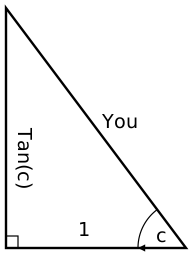

The fundamental trigonometric functions, Sin and Cos, are defined by ratios of sides of a right-angle triangle, as functions of an angle of the triangle.
In deference to the SI choice of unit of angle, I'll define the more usual functions (whose names I don't capitalise)
for which sin' = cos and
cos' = −sin. These dimensionless
forms of the trigonometric
functions are closely related to the exponential function, defined by exp' =
exp, exp(0) = 1; in the complex plane (with i as a square root of −1),
this is periodic with period 2.π.i and exp(i.t) = cos(t) +i.sin(t), to which
I'll return.
To complete the standard family of trigonometric functions, define the tangent, secant and their complements by:
secant,
The prefix co
generally means do it to the
angle's complement within a right-angle triangle
, i.e. coF = F∘(:
left−a ←a :), but since Cos is an even function
, i.e. Cos =
Cos∘(: −a ←a :), one can replace left−a with
a−left in some cases (as noted) – though not for Tan and coTan.
Some authors abbreviate the co-secant to csc rather than cosec. The usual
abbreviation for secant makes possible an obvious
if silly joke, potentially suitable for
a valentine's day card to a geek.
The studious reader can now use Pythagoras' theorem and the derivatives of Sin and Cos to verify that
and derive suitably negated equivalents for cotan and cosec. It is also possible to express each of the trigonometric function, as computed for an arbitrary angle, in terms of the tangent of half that angle.
hyperboliccompanion functions
As discussed elsewhere, exp(i.t) = cos(t) +i.sin(t), from which we may infer
which will allow us to extend our definitions of cos and sin from the
real line to the whole complex plane (by letting t range over the latter, rather
than restricting it to the former). Analogy with the usual trigonometric
functions encourages introduction of the so-called hyperbolic
companion
functions (so-called because their role in hyperbolae is analogous to that of
the trigonometric functions in circles):
for which cosh' = sinh, sinh' = cosh, with sinh(0) = 0 and cosh(0) = 1, while cosh(t).cosh(t) = 1 +sinh(t).sinh(t) for all t. Presumably cosech can be called csch, too.
The names of the functions all come from constructions involving a circle and a right-angle triangle. In each case, if the circle's radius is taken as unit of length, the function is the name of a line in the construction: otherwise, it is the ratio of this line's length to the radius.
A line which touches a circle without crossing it is called a tangent
(or tangent line
) from the Latin for touching
. If we draw a
radius of the circle through the point at which our tangent touches the circle,
the radius and tangent meet in a right angle. If we construct a second radius,
making angle a with the one to the touching-point, and extend this new radius
beyond the circle until it meets the tangent line, we obtain a right angle
triangle. One side of this triangle is an interval of the tangent line; its
length is Tan(a) times the circle's radius. The hypotenuse of this triangle is
known as a secant
(or secant line
) and is likewise Sec(a) times
the circle's radius. I
gather the word secant means cutting
or perhaps cutting the circle
twice or in two (it's one half of a diameter) but don't know enough Latin.
When a straight line cuts a circle, neither tangent nor through the center,
the part of the line inside the circle is known as a chord
. If we join
each end of the chord to the centre of the circle we get a triangle; two of its
sides are radii, so of equal length; the chord is said to subtend
the
angle in which these two radii meet. If we draw a radius of the circle through
the centre of the chord, the two meet in a right angle (the case of a tangent,
above, is just the limiting case of a chord of zero length); this radius also
bisects the angle subtended by the chord. Hindu mathematicians thus spoke of
the half-chord, or ardha-jiva
, as a function of the half-angle between
the bisecting radius and either end-radius of the chord. (Larry Gonick, in
volume III of his Cartoon History of the Universe, translates the Hindu term as
bow-string.) This got shortened to jiva
, transcribed into Arabic,
mis-read by some Europeans (in the 1300s) as an Arabic word with different
vowels, translated to Latin as sinus
and mangled into the
word sine
. (The history of words is full of craziness ;^)
The word trigonometry
comes from the Greek for measuring triangles.
The Sin and Cos functions encode Pythagoras' theorem as the assertion that the sum of their squares is one; and their addition formulae naturally enable us to infer their values at multiples of an angle, given their values at that angle. Consequently, given an angle a:
so that we are able to express all trigonometric functions (obviously we get Sec, coSec and coTan by inverting the above) of any given angle as functions of the tangent of half that angle.
We can do similar for the hyperbolic cousins, now with a simply real:
which is exactly the same aside from reversing the sing of the tan2 terms while making the functions hyperbolic.
 Written by Eddy.