I regularly visit NASA's picture of the day; I've also trawled
through the archive collecting links to nice
pictures and classifying them in a manner of my chosing. What a remarkable
universe we inhabit !
The distance light travels in a year is called a light year and its
standard abbreviation is ly; applying standard SI quantifiers, we get k ly for
a thousand light years, M ly for a million, G ly for a milliard of them and so
on. One millionth of a light year, a µly, is 9.46 million kilometres
(5.88 million miles). Light from the Sun takes 8.28 minutes (15.74 millionths
of a year) to reach the Earth.
The headings of some nested portions of the following list provide
links to searches in the
archive. This page comes with two style-sheets: a plain one and one
which folds away the parts you're not looking at – if your
browser supports suitable style features, of course. The folding version
(which takes some getting used to, but saves a lot of paging up and down; and
provides a hierarchic approach to finding things) depends on hover, which
might only work with a mouse; and only works if your browser considers all
ancestors of any hovered element to be hovered (it is not clear to me whether
the standards specify that).
Cosmic
Images of the whole sky, from one end of the spectrum to the other.
51 wide-angle photograph mosaic in visible light; and the same
author's later update using digital images. Each
is aligned so that the Milky Way runs along the centre.
or gamma-ray bursts and quasi-stellar objects, to give them their proper
names. Distant things of extreme brightness, implying spectacularly energetic
sources. GRBs have proven so elusive that a dedicated satellite, Swift, if
constantly on the look out for them, to alert other telescopes to look at their
sources before they can fade back into obscurity.
A
spiral and an ellipse; the latter is also known
as the cigar galaxy. Each is stirred up by the
tidal stresses of their mutual orbit, about 12 M ly
away in Ursa Major.
When they get crowded, things can get quite intense. Clusters tend to
comprise tens or hundreds of galaxies; groups are smaller. On a truly cosmic
scale, clusters can band together to form superclusters. When many galaxies
hang around close together, the intergalactic gas is apt to contribute
significantly to the total mass (of normal matter – dwarfed by the
accompanying dark matter) and is often hot enough to emit X-rays.
Several galaxies moving together, and a few
more imaged near them, within the Virgo cluster
which, being only about 48 M ly away, is the nearest cluster to (and has a
definite gravitational effect on)
our local
group; there are over 2000 galaxies in the cluster, which spans about 10
degrees on Earth's sky, so it's 8 to 12 M ly across.
Paul Hickson and
colleagues catalogued compact groups of galaxies, often in the process of
merging. They can be dramatic or, like clouds, suggest the shapes of more
familiar objects.
Dominated by central NGC 1275 (a.k.a. Perseus A; over 100 k ly across,
so only slightly wider than our galaxy, but rather more massive), the Perseus
cluster is roughly a quarter G ly away.
… combined, when hovered, with Chandra's X-ray and radio from
the Very Large Array.
Colliding Galaxies
When galaxies collide, the stars miss one another but the interstellar gas and
dust clouds get pummelled into bouts of star-forming. Violent prettiness
ensues.
NGC 4696, a large globular galaxy (150 M ly away) with a super-massive
black hole in it, generating huge amounts of energy which the galaxy radiates
in X and radio.
A globular galaxy (60 k ly across, 10 or 13 M ly away) with an
anomalous centre, about 1 k ly across, suspected of being the remains of a
spiral galaxy swallowed up about 0.1 G yr ago.
The elegant class of peers of our own Milky Way; galaxies in which most of the
stars lie in a disk and circulate in a common sense around its centre
(although, in some cases, there are two populations of stars, circulating in
opposite senses); they are usually dominated by dark dust lanes and a
few arms, in the form of equiangular
spirals. If they sometimes look like a pool
of water swirling round on its way to go down a plug-hole in the middle,
that's because the black hole in the middle is indeed a kind of cosmic
sink-hole.
Naturally, very few galaxies are exactly edge-on or face-on; but many are close
enough to one or the other for a rough, if somewhat arbitrary, classification.
The rest fall in between.
A spiral, a.k.a. NGC 1097, with long arms
tangling with a satellite about 43 k ly from the spiral's centre. NGC 1097 is
a Seyfert galaxy, 45 M ly away in Fornax, and turns
out to be emitting mysterious jets.
It's 11.8 M ly away, 70 k ly across and the principle member of a small
group (comparable to
our local
group). Its dance
with the cigar galaxy, eliptical M82, shall doubtless end in a union. Our
view of it is partially obscured by barely visible dust clouds just outside our
own galaxy, the integrated flux nebula (named after the subtle technique needed
to observe it), but individual stars are discernible.
Initially thought to be a stream of debris from M81's interaction
with neighbours, this patch of light turns out to be part of the fore-ground,
close to our own galaxy, coincidentally superimposed on M81.
Also known as the silver dollar galaxy or (after the constellation
it's in, and the eponymous group, of which it's the largest member) Sculptor
galaxy.
Our Milky Way Galaxy has a few travelling companions: one larger spiral galaxy,
Andromeda, and an assortment of about 30 smaller galaxies out to about 10 M ly
away.
Also known as triangulum (and pinwheel,
for bonus confusion with M101); may be orbiting Andromeda (M31). Over 50 k ly
across, the third largest member of the local
group (a quarter of the size of the first two) is about 3 M ly away.
M31: the even bigger member of our local group, 2.5 M ly away, with over twice
the diameter of the Milky Way and a million million stars, compared to 0.4
times that for the Milky Way.
Closest of the dwarfs being swallowed up by the Milky Way; only 42 k
ly from the Galactic center, and so spread out it's more a stream of debris
than a galaxy.
A young dwarf spheroidal galaxy, only just orbiting the Milky Way,
about a quarter M pc (.8 M ly) away.
Other nearby galaxies
Not quite close enough to be gravigationally bound to the group, some galaxies
are, none the less, close enough to interact with it. Parenthetical distances
here are how far away each is. See
also: M81, Centaurus
A
and irregular
galaxies.
Like its peers, our galaxy has a halo
of globular
clusters orbitting it (about 200 of them, in fact); and where a large cloud
of dust and gas
has collapsed
down to stars, once these have
finished blowing
away the remnants of the cloud, the
resulting open
cluster (a.k.a. galactic cluster) is often a beautiful sight, shining
like jewels in a box.
The largest globular cluster orbiting the Milky Way, c. 10 million
stars, 150 ly across, 15 or 18 k ly away and
including stars about 12 G yr old – so it dates from when the universe
was about a seventh of its present age – yet it includes newer stars,
suggesting it may be the last remains of a small
galaxy captured by the Milky Way.
The centre of the Milky Way: a turbulent place ruled by a black hole –
or, at least, the orbits of stars near the centre imply the presence of more
than two million times the mass of our Sun (Swarzchild radius almost eight and
a half times The Sun's radius) in a space less than 17 light hours (under 123
AU or 26.4 thousand times the Sun's radius) across.
Our Sun is in the same spur, between the two spiral
arms of the Milky Way, as the stars of Orion, after which this spur is
named. Orion's Great Nebula, M42, is a major stellar nursery, conveniently
visible thanks to violent winds from bright young stars, 1.5 k ly away and and
13 or so ly across.
Canaries Sky (La Palma) showing the nebulae and their structure:
Barnard's loop looks enough like a belly to make it easier to interpret the
constellation as a picture of a man.
Al Nitak (a.k.a. Zeta Orionis) lights up the Flame Nebula; not far away, a
sheet of glowing gas which we see side-on serves as back-drop to another dust
cloud, whose shadow evokes the shape of a horse's head.
Visible to the unaided eye as a fuzzy patch – just below and to
the left of Orion's belt – the Great Nebula rewards closer study. It's
a stellar nursery centred on a bright open cluster called The Trapezium. It
spans about 40 ly, lies about 1.5 k ly away and is expected to slowly disperse
over the next 0.1 M yr.
The new star (stella nova) recorded and studied
by Kepler and his peers in October 1604, without the aid of telescopes, gave
rise to the term nova; but it was actually what we'd now describe as a
type 1a supernova. This most recent stellar explosion in our galaxy happened
only 13 k ly away.
A super-nova about 11 k yr ago ejected a shock-wave so fast it still
travells a mega-metre in about seven seconds, producing a rippled sheet of
glowing gas as it hits its surroundings. This remnant's diameter is about 100
ly, so the shock-wave's average speed has been around c/220, roughly ten times
its present speed.
Whispy remains of a super-nova seen on Earth about 7.5 k yr ago; as the
shockwave hits nearby clouds of gas and dust, it glows prettily. It's about
1.4 k ly away and around 70 ly across.
The black hole left behind by the supernova may well be a microquasar;
the relativistic jets of gas bouncing off its acretion disk cause a bubble
nebula rapidly expanding outwards from it, near
the Northern Cross.
Ejecta from the explosion spread outwards, bashing everything they meet so
hard they dislodge even the inner electrons of heavy elements – making
them bright even at high energies. Several of these images are from the
Chandna observatory.
Not only is its neutron star far off
centre; its wake points in the wrong direction, suggesting vigorous flows
in the remnant gas. About 5 k ly away and 65 ly across.
Not
really a nebula, but a fuzzy blob anyway; Zeta Ophiuchi is moving fast through
interstellar material, likely after being launched away by a dying
partner.
AE Aurigae
and the accompanying Flaming Star Nebula, IC405. The star is actually
a refugee from Orion, escaping at 90 km/s (Auriga, the charioteer, would be
proud), and the Nebula is a dust cloud it just happens to be passing
through.
The largest stellar nursery in our Local Group. Big hot young new
stars blast caverns, filled with X-ray-emitting
gas, in a dust cloud in spiral galaxy M33, Triangulum, a.k.a. Pinwheel.
Infra-red view
shows stars through the dusty cocoons that hide them from visible view.
The
Carina Nebula
An even larger star-forming region than Orion, over 300 ly across, NGC
3372 looks (to me, in some views) like a flint arrow-head, with the keyhole
nebula embedded in it. It's the context
for Eta
Carinae, which lights it up, sculpts it and may one day blow it to
smithereens; so I'm glad its 7.5 k ly away.
450 ly away, 2/3 of a ly across; a molecular cloud being blown away by
the star it's created in its heart.
Stellar provocation
The winds from hot young stars, or the shock-wave from a supernova, can
compress and agitate a cloud of dust and gas, provoking the formation of new
stars.
Star cluster Hodge 301, a Denizen of the
Tarantula Nebula, with red giants due to blow, seeding the nebula with
more pressure waves to make more stars.
NGC 6543 is a planetary nebula, over half a light-year across, about 3 k ly
away but looks a bit like a deep-sea blobby life-form. It's filamets and
inner folds are marvelously intricate. It is surrounded
by an outer halo that spans three light
years.
20 k ly away, in the constellation Monocerotis, on the edge of our
galaxy, a quite unusual star, V838 Mon, had an outburst: the light from that
first came to us directly in January 2002; but now we get to watch the light
illuminate the surrounding cloud – the outer layers the star had
previously shed.
As the Sun is just an ordinary star, surely other stars may have
satellites like the planets of our solar system. As our astronomical equipment
has improved, we have begun to catch glimpses of these companions; and even
launched specialist space probes to look for them; for example, in 1/400 of the
sky, the
Kepler probe has found over 1200 possible
exoplanets (and it can only see ones whose orbital planes pass through
us).
Only 25 ly away, Formalhaut is young: its surrounding debris ring
hasn't stabilized into the serene splendour of a system of planets, but one
planet is visible among it, about three times as massive as Jupiter, with 14
times the orbital radius.
500 ly away a newly-formed sun-like star is observed, in infra-red,
(and later confirmed) to have a
companion. Estimated to be about 8 times as massive as Jupiter, it's 330 AU
(1.9 light days) from its star – 63.4 time as far as Jupiter is from our
Sun.
It's only a red dwarf, but (to the best of 2007's knowledge) has a
planet a bit bigger than Earth orbiting it once every 13 days, at such a
radius as to have a likely surface temperature of
zero to 40 Celsius. With a mass estimated to be 5 times that of Earth, and a
diameter 1.5 times that of Earth, its surface gravity is about twice that of
Earth. This is 20 ly from home.
Further study of Gliese 581's system of planets had, by 2010,
identified a planet (not sure if this is better data on the same as above, or
a different one) in circular orbit with period 37 days; relative to the
matching properties of Earth, its mass is 3.1, orbital radius 0.15, body
radius 1.5, surface gravity between 1.1 and 1.7.
Rather further afield, 130 ly away, HR 8799 has 1.5 times the mass of
our Sun and is seen (in infra-red) to be orbited by at least three gas giants,
likely bigger than Jupiter, all with orbital radii larger than that of
Neptune.
The nearest star to the Sun, 4.22 light years away; so faint it wasn't
found until 1915, despite being in orbit around
the fourth brightest star in the night sky.
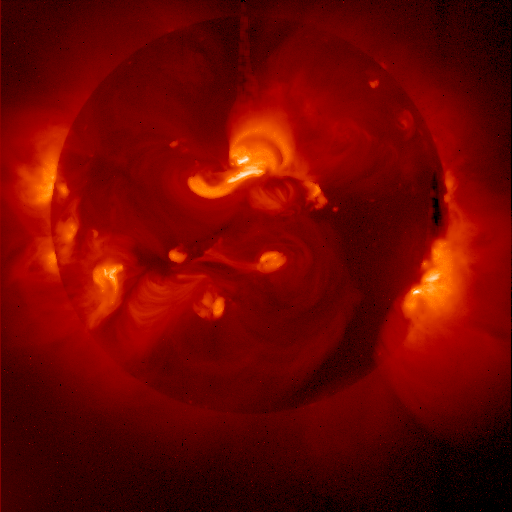
It looks so serene and perfect until you study it closely and discover that
it's a raging inferno in perpetual turmoil. Galileo was the first to see it
thus; since 1995 the SOlar and
Heliospheric Observatory, in Earth's L1 Lagrange point, has hugely
enriched our knowledge of our nearest star's tumult.
Spots, flares, prominences and coronal mass ejections
Despite the fierce gravity at the Sun's surface, there's so much
activity at the surface that some of the matter escapes; some even hangs
suspended above the surface – known as prominences when seen at The
Sun's limb, against the dark back-drop of space, or as filaments when seen
against the The Sun itself.
By a happy coincidence, we are living in an epoch in which the Moon's distance
from the Earth (which slowly increases) is in the same ratio to the Moon's
diameter as the ratio of the Earth's distance from the Sun to the diameter of
the Sun – to an approximation good enough that routine variations in the
distances involved suffice to make each ratio sometimes larger than the other.
Consequently, when the Moon passes between Earth and Sun, it can exactly mask
out the whole of the Sun's body, revealing its magnificent corona.
Satellites of our Sun which: are big enough that their own gravitation
obliges them to be roughly spherical, and; constitute most of the mass in
orbits near their own; are classified as planets – or major
planets, to distinguish them from Pluto, which
also gets described (mainly thanks to historical accident) as a planet. The
eight major planets fall into two groups, separated by the asteroid belt: the
four outer planets are gas giants, of low density thanks to vast amounts of
Hydrogen in their atmospheres; the four inner planets are much smaller balls
of rock, with atmospheres (where present) dominated by less cosmically
abundant – but weightier – substances.
Named for the messenger of the gods. Has negligible atmosphere. NASA's
Messenger probe has, in early 2008, made the first of a series of fly-bys that
shall ultimately put it into a mapping orbit on 2011, March 18th; it has
already greatly expanded on the limited data from the one earlier visitor,
Mariner 10, in 1974. In 2013, Europe and Japan shall launch a joint mission
to Mercury, Bepi-Colombo, which shall include X-ray sensing.
Named for the godess of love. Venus is a common way-station for space-craft
heading out to the gas giants and beyond; it provides a
handy gravity-assist.
Its atmosphere is apallingly corrosive, immensely thick and hot – the
first few space-craft we sent there were destroyed before the reached ground
level !
At intervals
of a
bit over a century, Venus and Earth manage to line up twice, eight years
apart, in such a way that observers on Earth see Venus pass across the face of
the Sun. It happened in 2004 and it'll happen again in 2012.
Named for the god of war. When at its closest to us (in opposition,
i.e. opposite the Sun), Mars shows us its full day-lit face; given how thin
its atmosphere is, this has given us a nice clear view of its surface. When
the best telescopes couldn't quite resolve the details, but nearly could, its
surface features looked tantalizing almost comprehensible – leading to
some rather fanciful guess-work.
Among thousands of hill-ish shapes in pictures, it should be no
surprise that at least one vaguely resembled a pattern our brains are
hard-wired never miss, at the expense of sporadic false positives. Sure
enough, more recent pictures show a less
surprising mesa.
Also in 2003, NASA sent two Mars Exploration Rovers, which (having
landed safely, unlike Beagle 2) have been sending back excellent images long
after their original design lifetimes of 90 days. They travelled separately
but both landed in January 2004. Spirit explores rocks and hills within Gusev
Crater while Opportunity, half a world away, visits a selection of smaller
craters.
Launched in August 2005, the MRO is dedicated to looking for signs
that there was ever persistent water on Mars's surface. It reached Mars in
March 2006 and has since been sending back a wealth of excellent images from
its high resolution
cameras, notably
including HiRISE.
Amid its bands of stormy clouds, fast-spinning Jupiter
sports a giant
storm; Hooke (1664) and Cassini (1665) first described such features, one
of which may be the same as has been consistently observed since the
1830s. With extents of 12–14 Mm in latitude and 24–40 Mm in
longitude, the area it covers is roughly equal to the total surface area of
the Earth.
Particle Sizes in Saturn's Rings – Cassini sent radio waves
home; reception revealed data on particle sizes in the centimeter range; there
may well be bigger ones …
Newly discovered in late 2009, with a radius over fifty times that of
Saturn's E-ring and thicker than several times Saturn's radius.
… and their shadows
The rings cast shadows on Saturn, with often pretty effects. As a
bonus, near Saturn's equinox (2009/August), Saturn's moons and the rings cast
shadows on the rings themselves, revealing details of their structure that
would otherwise be hard to see.
Excellent crisp image; separate rings' shadows form a neat pattern of
lines on Saturn. Crescent Tethys shows its clear disk just sun-ward of the
Planet's terminator.
Some planets have moons (also called satellites) trapped in orbit around
them; and there are assorted other stray lumps of matter floating around the
solar system.
Selene
Better known as The Moon, Earth's constant companion, always
keeping the same face
towards Earth. Its unprotected surface, bombarded by cosmic
rays, shines brightly in γ-rays, brighter by
far than The Sun.
The Earth's shadow comprises, as one moves away from the Sun, a slowly narrowing
cone of total darkness, where Earth hides all of the Sun, within a slowly
widening cone of partial darkness, where at least some of the Sun is
hidden. Selene's diameter is less than that of either, at the distance of her
orbit, so she easilly fits into the shadow, when her path happens to take her
through it. When the whole of the moon is inside the cone of total darkness,
it's a total eclipse of the moon; when otherwise at least partially within the
cone of partial darkness, it's a partial eclipse.
Stray lumps of rock in roughly circular orbits about the Sun are known
as minor
planets; those which orbit (mostly) closer than Jupiter are known
as asteroids;
the ones caught at Jupiter's Lagrange points (leading and trailing Jupiter by
turn/6) are known as Trojans; those orbiting (mostly) between Jupiter and
Neptune are known as Centaurs. Beyond Neptune, there's a zone known as the
Kuiper belt (sometimes: Edgeworth-Kuiper belt) in which many similar bodies
orbit; including Pluto, king of the minor planets (though not actually the
largest of
them). The asteroids
of the inner solar system attract plenty of attention, now that we've
realised how close some of them come to hitting
Earth.
First observed triple asteroid; 380 km Sylvia; 710 km, 33 hr orbit for
7 km Remus; 1360 km, 87.6 hr orbit for 18 km Romulus. Rhea Sylvia was the
wolf-cubs' mother.
A gallery of the asteroids and comets visited by our space-craft, to
date, to mark the occasion of ESA's Rosetta's fly-by of 21 Lutetia, the
largest in the gallery.
The first
asteroid
found, Ceres
(933 km in diameter), filled a gap in the Titius-Bode sequence: start with 0
and 0.3, then double at each subsequent step to get 0.6, 1.2 and so on; add
0.4 to each entry in that sequence; you now have 0.4, 0.7, 1.0, 1.6, 2.8, 5.2,
10.0, 19.6; which are respectably close to the orbital radii of the planets
out to Uranus (measured as multiples of Earth's orbital radius), save for the
entry between Mars (1.52296 ≅ 1.5) and Jupiter (5.1998 ≅ 5.2). Once
this coincidence had been noticed, astronomers went looking for a planet
orbitting at the missing radius – after the satisfying success
of finding Ceres (on
the first day of the nineteenth century, in an orbit with radius 2.77 times as
big as Earth's), they were a little surprised to find it was (rather small
and) not
alone
– Pallas, Vesta
and Juno showed
up soon after.
Jovial
The moons of Jupiter caused quite a stir when Galileo first noticed
them. More recently, they've proven even more
interesting when
seen from closer range.
Saturn has plenty of moons plus a beautiful system of rings. It also has an
artificial satellite, called Cassini, which has sent us back lots of
delightful pictures.
Twin moons with orbital radii within 50 km, 91 Mm above Saturn's
cloud-tops, doing a perpetual dance – swapping orbits every four years
and sheperding the A ring. Epimetheus is about 115 km across; Janus is about
190 km across, with a shape reminiscent of a potato.
Mimas (not the death star from Star Wars) seen (c/o
Cassini) half-face, with its (130 km span) huge nippled
crater, Herschel, facing us on the
terminator.
Another Lagrange pair, just outside the E ring. Dione is mostly water ice, but
has enough rock to make it perceptibly heavy. Icy Polydeuces occupies the rear
Lagrange point.
Saturn's largest moon (second largest in the Solar system, behind
Jupiter's Ganymede) has an atmosphere, so Cassini took Huygens to visit Titan
and get us some more detailed information. Most of the following are images
Cassini itself took, using radar to see through the atmosphere, during its
many fly-bys. Titan's surface temperature
is about
93 K and its atmosphere is dominated by methane.
Irregular dark surface, retrograde orbit, low density – suspect
Kuiper belt refugee, now in Saturn's orbit. Looks just like the Clangers'
home planet ;^)
Uranic
Much remains to be seen of Uranus and its environs; but we know it also has
rings.
Some of the dirty snow-balls that populate the outer reaches of the solar
system get disturbed into highly eccentric orbits that bring them sporadically
into the inner solar system; this exposes them to The Sun's heat, causing them
to partially evaporate, thereby releasing loose dust and debris, which reflect
the Sun's light and produce a spectacular bright appearance, often visible to
the naked eye from Earth. These transient visitors are known as comets (the
word comes from a latin word for hair, comes) and give
photographers an excuse to capture them against often beautiful
foregrounds.
This comet was chosen as the target for the Deep Impact probe,
which deliberately crashed into it, to help us learn more about cometary
structure. Images below are of the comet's solid nucleus.
When first seen, Pluto was classified as a planet. Its apparent size had to be
revised downwards (it's actually smaller than several moons of other planets,
including our own) when it was discovered that its apparent diameter and the
amount of light apparently from it arose from its having a relatively large
moon, Charon. It's since emerged that plenty of other bodies are in orbits
similar to its (eccentric, tilted from the ecliptic and in a resonance with
Neptune's orbit), constituting the inner class
of trans-Neptunian
objects (TNOs). The orbits of these, in turn, overlap with those
of a second
population of similar bodies in roughly circular orbits; this population
matches fairly well with what Edgeworth and Kuiper postulated to explain the
origin of comets. Beyond this (but again overlapping its orbits) are further
bodies in elliptical orbits, reaching far out towards the cold depths of
inter-stellar space. Among these three populations, folk have found assorted
bodies of size comparable with, and bigger than, Pluto. With Pluto thus
revealed as merely a prominent member of one of several populations of
TNOs, it was downgraded from planet
status in 2006, just as Ceres had been when it turned out to be merely the
biggest of another population
– the
asteroids. TNOs are generally dirty snow-balls; the comets, above, are ones
that have been dislodged into unusual orbits.
Twice as distant as Pluto – and bigger, thereby forcing the
issue of what criteria a body must satisfy to deserve to be deemed a
planet. Once that was resolved, in August of 2006, Pluto was a dwarf planet
and the body which had provoked its
demotion was
given the name Eris (goddess
of discord –
warmonger, the cause of conflict, the source of competitive rivalry –
not of chaos, as some prefer to think). Apparently she
has a
moon, Dysnomia (goddess of lawlessness; perhaps those who identify Eris
with chaos should credit her with the virtue of disobedience). Eris was,
before being officially named, nick-named Zena, after a character (in the
eponymous television program) played by Lucy Lawless.
With so much to learn about the outer reaches, a probe is now on its
way to study them from close-up. Launched in January 2006 and faster than any
probe before it, it'll still take until 2015 to reach Pluto.
Views from home
Distant things seen alongside the veiwer's context.
When little bits of space rubble hit the atmosphere, they burn up in
quick streaks of light. Comets fill their orbits with dust and grit, which
manifest as meteor showers when Earth passes through a comet's orbit.
A chance picture – along with news of a metre-scale
asteroid, 2008 TC3, discovered less than a day
before its destruction on hitting Earth's atmosphere; it was very intensely
studied in that brief interval.
In 1966, Lunar Orbiter 1 looked back across the moon at Earth. Only
black-and-white, but the detailed fore-ground Moon makes up for the blurry
Earth. And it was first. Better still, it's
even been restored, bringing out more
detail.
Apollo 11's Lunar Module, on its way back to the Command Module,
heading home from its historic mission, with Earth on the horizon. See also
a stereoscopic anaglyph from a few moments before
or after.
I maintain there is much more wonder in science than in pseudoscience. And in
addition, to whatever measure this term has any meaning, science has the
additional virtue, and it is not an inconsiderable one, of being
true.
Carl Sagan, The Burden Of Skepticism, The
Skeptical Inquirer, Vol. 12, Fall 87
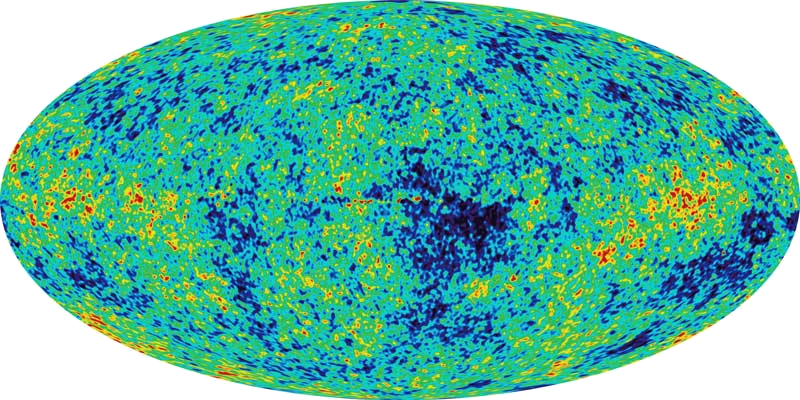 Images of the whole sky, from one end of the spectrum to the other.
 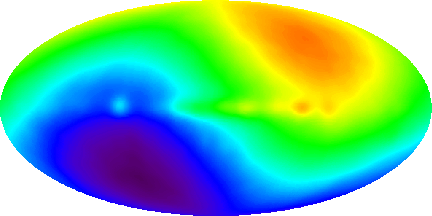 Doppler dipole dominates variation in the cosmic microwave background.
  If you stare into an apparently empty bit of sky for long enough, you'll see
stars; they're just further away than the others.
If you stare into an apparently empty bit of sky for long enough, you'll see
stars; they're just further away than the others.  or gamma-ray bursts and quasi-stellar objects, to give them their proper
names. Distant things of extreme brightness, implying spectacularly energetic
sources. GRBs have proven so elusive that a dedicated satellite, Swift, if
constantly on the look out for them, to alert other telescopes to look at their
sources before they can fade back into obscurity.
or gamma-ray bursts and quasi-stellar objects, to give them their proper
names. Distant things of extreme brightness, implying spectacularly energetic
sources. GRBs have proven so elusive that a dedicated satellite, Swift, if
constantly on the look out for them, to alert other telescopes to look at their
sources before they can fade back into obscurity.  Groups, clusters and collisions.
  Paul Hickson and
colleagues catalogued compact groups of galaxies, often in the process of
merging. They can be dramatic or, like clouds, suggest the shapes of more
familiar objects.
Paul Hickson and
colleagues catalogued compact groups of galaxies, often in the process of
merging. They can be dramatic or, like clouds, suggest the shapes of more
familiar objects.  When galaxies collide, the stars miss one another but the interstellar gas and
dust clouds get pummelled into bouts of star-forming. Violent prettiness
ensues.
When galaxies collide, the stars miss one another but the interstellar gas and
dust clouds get pummelled into bouts of star-forming. Violent prettiness
ensues.  Individual island universes: jewels nestling deep in the velvet blackness of
the sky.
Individual island universes: jewels nestling deep in the velvet blackness of
the sky.  The elegant class of peers of our own Milky Way; galaxies in which most of the
stars lie in a disk and circulate in a common sense around its centre
(although, in some cases, there are two populations of stars, circulating in
opposite senses); they are usually dominated by dark dust lanes and a
few
The elegant class of peers of our own Milky Way; galaxies in which most of the
stars lie in a disk and circulate in a common sense around its centre
(although, in some cases, there are two populations of stars, circulating in
opposite senses); they are usually dominated by dark dust lanes and a
few  Naturally, very few galaxies are exactly edge-on or face-on; but many are close
enough to one or the other for a rough, if somewhat arbitrary, classification.
The rest fall in between.
Naturally, very few galaxies are exactly edge-on or face-on; but many are close
enough to one or the other for a rough, if somewhat arbitrary, classification.
The rest fall in between.  The view that best exposes (often photogenic) dust-lanes.
  Our Milky Way Galaxy has a few travelling companions: one larger spiral galaxy,
Andromeda, and an assortment of about 30 smaller galaxies out to about 10 M ly
away.
Our Milky Way Galaxy has a few travelling companions: one larger spiral galaxy,
Andromeda, and an assortment of about 30 smaller galaxies out to about 10 M ly
away.  M31: the even bigger member of our local group, 2.5 M ly away, with over twice
the diameter of the Milky Way and a million million stars, compared to 0.4
times that for the Milky Way.
M31: the even bigger member of our local group, 2.5 M ly away, with over twice
the diameter of the Milky Way and a million million stars, compared to 0.4
times that for the Milky Way.  Not quite close enough to be gravigationally bound to the group, some galaxies
are, none the less, close enough to interact with it. Parenthetical distances
here are how far away each is. See
also: M81, Centaurus
A
and irregular
galaxies.
Not quite close enough to be gravigationally bound to the group, some galaxies
are, none the less, close enough to interact with it. Parenthetical distances
here are how far away each is. See
also: M81, Centaurus
A
and irregular
galaxies.  The smaller of the two big spirals dominating
our local
group.
The smaller of the two big spirals dominating
our local
group.  Like its peers, our galaxy has a halo
of globular
clusters orbitting it (about 200 of them, in fact); and where a large cloud
of dust and gas
has collapsed
down to stars, once these have
finished blowing
away the remnants of the cloud, the
resulting open
cluster (a.k.a. galactic cluster) is often a beautiful sight, shining
like jewels in a box.
Like its peers, our galaxy has a halo
of globular
clusters orbitting it (about 200 of them, in fact); and where a large cloud
of dust and gas
has collapsed
down to stars, once these have
finished blowing
away the remnants of the cloud, the
resulting open
cluster (a.k.a. galactic cluster) is often a beautiful sight, shining
like jewels in a box.  The centre of the Milky Way: a turbulent place ruled by a black hole –
or, at least, the orbits of stars near the centre imply the presence of more
than two million times the mass of our Sun (Swarzchild radius almost eight and
a half times The Sun's radius) in a space less than 17 light hours (under 123
AU or 26.4 thousand times the Sun's radius) across.
The centre of the Milky Way: a turbulent place ruled by a black hole –
or, at least, the orbits of stars near the centre imply the presence of more
than two million times the mass of our Sun (Swarzchild radius almost eight and
a half times The Sun's radius) in a space less than 17 light hours (under 123
AU or 26.4 thousand times the Sun's radius) across.  Our Sun is in the same spur, between the two spiral
arms of the Milky Way, as the stars of Orion, after which this spur is
named. Orion's Great Nebula, M42, is a major stellar nursery, conveniently
visible thanks to violent winds from bright young stars, 1.5 k ly away and and
13 or so ly across.
Our Sun is in the same spur, between the two spiral
arms of the Milky Way, as the stars of Orion, after which this spur is
named. Orion's Great Nebula, M42, is a major stellar nursery, conveniently
visible thanks to violent winds from bright young stars, 1.5 k ly away and and
13 or so ly across.  Al Nitak (a.k.a. Zeta Orionis) lights up the Flame Nebula; not far away, a
sheet of glowing gas which we see side-on serves as back-drop to another dust
cloud, whose shadow evokes the shape of a horse's head.
Al Nitak (a.k.a. Zeta Orionis) lights up the Flame Nebula; not far away, a
sheet of glowing gas which we see side-on serves as back-drop to another dust
cloud, whose shadow evokes the shape of a horse's head.  When a big star reaches the end of its life, it goes out spectacularly. The
remnants are often quite fascinating.
When a big star reaches the end of its life, it goes out spectacularly. The
remnants are often quite fascinating.  Ejecta from the explosion spread outwards, bashing everything they meet so
hard they dislodge even the inner electrons of heavy elements – making
them bright even at high energies. Several of these images are from the
Chandna observatory.
Ejecta from the explosion spread outwards, bashing everything they meet so
hard they dislodge even the inner electrons of heavy elements – making
them bright even at high energies. Several of these images are from the
Chandna observatory.  M1: remnant from a supernova witenessed in 1054 CE.
  Miscellaneous fuzzy blobs in the sky. See also: Emission
Nebulae.
Miscellaneous fuzzy blobs in the sky. See also: Emission
Nebulae.  Several
stars together can achieve some major impact.
Several
stars together can achieve some major impact.  A particularly pretty fuzzy blob, 3 k ly away in the constellation Monoceros
  The birth of stars is a dramatic process – and often pretty.
  Massive stars forming in a cloud …
 The
Carina Nebula
The
Carina Nebula When we can distinguish a single star forming, we can sometimes almost make
out what's orbiting it…
When we can distinguish a single star forming, we can sometimes almost make
out what's orbiting it…  About 50 ly across and 5 k ly away, towards Sagittarius; also known as M20.
  2 k ly away, about 20 ly across in the constellation Cepheus; seen at right in
SHO light.
2 k ly away, about 20 ly across in the constellation Cepheus; seen at right in
SHO light.  Assorted nurseries in one of our home galaxy's close satellites.
  Planetary Nebulae: when a star of modest size
(such as our Sun) grows old, it sheds its outer layers. The results can be
marvelously pretty.
Planetary Nebulae: when a star of modest size
(such as our Sun) grows old, it sheds its outer layers. The results can be
marvelously pretty.  Star gone boom – surrounded by fronds and glowy-ness.
  Many planetary nebulae have a pronounced spreading along an axis.
  Sometimes, the star hollows out a bubble
in the middle of its planetary nebula, generally with beautiful results.
Sometimes, the star hollows out a bubble
in the middle of its planetary nebula, generally with beautiful results.  NGC 6543 is a planetary nebula, over half a light-year across, about 3 k ly
away but looks a bit like a deep-sea blobby life-form. It's filamets and
inner folds are marvelously intricate. It is surrounded
by an outer halo that spans three light
years.
NGC 6543 is a planetary nebula, over half a light-year across, about 3 k ly
away but looks a bit like a deep-sea blobby life-form. It's filamets and
inner folds are marvelously intricate. It is surrounded
by an outer halo that spans three light
years.  We can more readilly learn about stars nearer to us.
 It looks so serene and perfect until you study it closely and discover that
it's a raging inferno in perpetual turmoil. Galileo was the first to see it
thus; since 1995 the SOlar and
Heliospheric Observatory, in Earth's L1 Lagrange point, has hugely
enriched our knowledge of our nearest star's tumult.
It looks so serene and perfect until you study it closely and discover that
it's a raging inferno in perpetual turmoil. Galileo was the first to see it
thus; since 1995 the SOlar and
Heliospheric Observatory, in Earth's L1 Lagrange point, has hugely
enriched our knowledge of our nearest star's tumult.  By a happy coincidence, we are living in an epoch in which the Moon's distance
from the Earth (which slowly increases) is in the same ratio to the Moon's
diameter as the ratio of the Earth's distance from the Sun to the diameter of
the Sun – to an approximation good enough that routine variations in the
distances involved suffice to make each ratio sometimes larger than the other.
Consequently, when the Moon passes between Earth and Sun, it can exactly mask
out the whole of the Sun's body, revealing its magnificent corona.
By a happy coincidence, we are living in an epoch in which the Moon's distance
from the Earth (which slowly increases) is in the same ratio to the Moon's
diameter as the ratio of the Earth's distance from the Sun to the diameter of
the Sun – to an approximation good enough that routine variations in the
distances involved suffice to make each ratio sometimes larger than the other.
Consequently, when the Moon passes between Earth and Sun, it can exactly mask
out the whole of the Sun's body, revealing its magnificent corona.  Named for the messenger of the gods. Has negligible atmosphere. NASA's
Messenger probe has, in early 2008, made the first of a series of fly-bys that
shall ultimately put it into a mapping orbit on 2011, March 18th; it has
already greatly expanded on the limited data from the one earlier visitor,
Mariner 10, in 1974. In 2013, Europe and Japan shall launch a joint mission
to Mercury, Bepi-Colombo, which shall include X-ray sensing.
Named for the messenger of the gods. Has negligible atmosphere. NASA's
Messenger probe has, in early 2008, made the first of a series of fly-bys that
shall ultimately put it into a mapping orbit on 2011, March 18th; it has
already greatly expanded on the limited data from the one earlier visitor,
Mariner 10, in 1974. In 2013, Europe and Japan shall launch a joint mission
to Mercury, Bepi-Colombo, which shall include X-ray sensing.  Named for the godess of love. Venus is a common way-station for space-craft
heading out to the gas giants and beyond; it provides a
handy gravity-assist.
Its atmosphere is apallingly corrosive, immensely thick and hot – the
first few space-craft we sent there were destroyed before the reached ground
level !
Named for the godess of love. Venus is a common way-station for space-craft
heading out to the gas giants and beyond; it provides a
handy gravity-assist.
Its atmosphere is apallingly corrosive, immensely thick and hot – the
first few space-craft we sent there were destroyed before the reached ground
level !  The planet on which I was born.
  Named for the god of war. When at its closest to us (in opposition,
i.e. opposite the Sun), Mars shows us its full day-lit face; given how thin
its atmosphere is, this has given us a nice clear view of its surface. When
the best telescopes couldn't quite resolve the details, but nearly could, its
surface features looked tantalizing almost comprehensible – leading to
some rather fanciful guess-work.
Named for the god of war. When at its closest to us (in opposition,
i.e. opposite the Sun), Mars shows us its full day-lit face; given how thin
its atmosphere is, this has given us a nice clear view of its surface. When
the best telescopes couldn't quite resolve the details, but nearly could, its
surface features looked tantalizing almost comprehensible – leading to
some rather fanciful guess-work.  In 1997, NASA's dedicated survey mission arrived and went to work – now
we have really good pictures of all of Mars, from close up.
In 1997, NASA's dedicated survey mission arrived and went to work – now
we have really good pictures of all of Mars, from close up.  ESA's orbiting observer arrived at the end of 2003. Its passenger, the Beagle
2 lander, failed; but the satellite has sent back some fine imagery.
ESA's orbiting observer arrived at the end of 2003. Its passenger, the Beagle
2 lander, failed; but the satellite has sent back some fine imagery.  or, at least, from Earth Orbit – mostly from the Hubble space telescope:
  Named for the king of the gods.
  Named after the father of Jupiter.
  Visible, even with early telescopes, from Earth: we now know that the other
gas giants have ring systems, too, but we knew about Saturns's first.
Visible, even with early telescopes, from Earth: we now know that the other
gas giants have ring systems, too, but we knew about Saturns's first.  Named after a mythical character from the ancient pagen world, father of Saturn.
  Named after the god of the sea.
  Better known as The Moon, Earth's constant companion, always
keeping the same face
towards Earth. Its unprotected surface, bombarded by cosmic
rays, shines brightly in γ-rays, brighter by
far than The Sun.
Better known as The Moon, Earth's constant companion, always
keeping the same face
towards Earth. Its unprotected surface, bombarded by cosmic
rays, shines brightly in γ-rays, brighter by
far than The Sun.  The Earth's shadow comprises, as one moves away from the Sun, a slowly narrowing
cone of total darkness, where Earth hides all of the Sun, within a slowly
widening cone of partial darkness, where at least some of the Sun is
hidden. Selene's diameter is less than that of either, at the distance of her
orbit, so she easilly fits into the shadow, when her path happens to take her
through it. When the whole of the moon is inside the cone of total darkness,
it's a total eclipse of the moon; when otherwise at least partially within the
cone of partial darkness, it's a partial eclipse.
The Earth's shadow comprises, as one moves away from the Sun, a slowly narrowing
cone of total darkness, where Earth hides all of the Sun, within a slowly
widening cone of partial darkness, where at least some of the Sun is
hidden. Selene's diameter is less than that of either, at the distance of her
orbit, so she easilly fits into the shadow, when her path happens to take her
through it. When the whole of the moon is inside the cone of total darkness,
it's a total eclipse of the moon; when otherwise at least partially within the
cone of partial darkness, it's a partial eclipse.  Mars has two natural mooons, both suspected of being captured asteroids, plus
a variable population of man-made visitors.
Mars has two natural mooons, both suspected of being captured asteroids, plus
a variable population of man-made visitors.  Stray lumps of rock in roughly circular orbits about the Sun are known
as minor
planets; those which orbit (mostly) closer than Jupiter are known
as asteroids;
the ones caught at Jupiter's Lagrange points (leading and trailing Jupiter by
turn/6) are known as Trojans; those orbiting (mostly) between Jupiter and
Neptune are known as Centaurs. Beyond Neptune, there's a zone known as the
Kuiper belt (sometimes: Edgeworth-Kuiper belt) in which many similar bodies
orbit; including Pluto, king of the minor planets (though not actually the
largest of
them). The asteroids
of the inner solar system attract plenty of attention, now that we've
realised how close some of them come to hitting
Earth.
Stray lumps of rock in roughly circular orbits about the Sun are known
as minor
planets; those which orbit (mostly) closer than Jupiter are known
as asteroids;
the ones caught at Jupiter's Lagrange points (leading and trailing Jupiter by
turn/6) are known as Trojans; those orbiting (mostly) between Jupiter and
Neptune are known as Centaurs. Beyond Neptune, there's a zone known as the
Kuiper belt (sometimes: Edgeworth-Kuiper belt) in which many similar bodies
orbit; including Pluto, king of the minor planets (though not actually the
largest of
them). The asteroids
of the inner solar system attract plenty of attention, now that we've
realised how close some of them come to hitting
Earth.  Colour-enhanced, main-belt asteroid; about 11 miles long.
 The moons of Jupiter caused quite a stir when Galileo first noticed
them. More recently, they've proven even more
interesting when
seen from closer range.
The moons of Jupiter caused quite a stir when Galileo first noticed
them. More recently, they've proven even more
interesting when
seen from closer range.  Icy on the outside, but might there be life in oceans within ?
 The largest moon in the Solar System – bigger than Mercury and Pluto.
  Saturn has plenty of moons plus a beautiful system of rings. It also has an
artificial satellite, called Cassini, which has sent us back lots of
delightful pictures.
Saturn has plenty of moons plus a beautiful system of rings. It also has an
artificial satellite, called Cassini, which has sent us back lots of
delightful pictures.  Another Lagrange pair, just outside the E ring. Dione is mostly water ice, but
has enough rock to make it perceptibly heavy. Icy Polydeuces occupies the rear
Lagrange point.
Another Lagrange pair, just outside the E ring. Dione is mostly water ice, but
has enough rock to make it perceptibly heavy. Icy Polydeuces occupies the rear
Lagrange point.  Much remains to be seen of Uranus and its environs; but we know it also has
rings.
Much remains to be seen of Uranus and its environs; but we know it also has
rings.  Neptune is so far away we can't see its moons very well; it has (at least)
six, plus a system of rings.
Neptune is so far away we can't see its moons very well; it has (at least)
six, plus a system of rings.  Some of the dirty snow-balls that populate the outer reaches of the solar
system get disturbed into highly eccentric orbits that bring them sporadically
into the inner solar system; this exposes them to The Sun's heat, causing them
to partially evaporate, thereby releasing loose dust and debris, which reflect
the Sun's light and produce a spectacular bright appearance, often visible to
the naked eye from Earth. These transient visitors are known as comets (the
word comes from a latin word for hair, comes) and give
photographers an excuse to capture them against often beautiful
foregrounds.
Some of the dirty snow-balls that populate the outer reaches of the solar
system get disturbed into highly eccentric orbits that bring them sporadically
into the inner solar system; this exposes them to The Sun's heat, causing them
to partially evaporate, thereby releasing loose dust and debris, which reflect
the Sun's light and produce a spectacular bright appearance, often visible to
the naked eye from Earth. These transient visitors are known as comets (the
word comes from a latin word for hair, comes) and give
photographers an excuse to capture them against often beautiful
foregrounds.  When first seen, Pluto was classified as a planet. Its apparent size had to be
revised downwards (it's actually smaller than several moons of other planets,
including our own) when it was discovered that its apparent diameter and the
amount of light apparently from it arose from its having a relatively large
moon, Charon. It's since emerged that plenty of other bodies are in orbits
similar to its (eccentric, tilted from the ecliptic and in a resonance with
Neptune's orbit), constituting the inner class
of
When first seen, Pluto was classified as a planet. Its apparent size had to be
revised downwards (it's actually smaller than several moons of other planets,
including our own) when it was discovered that its apparent diameter and the
amount of light apparently from it arose from its having a relatively large
moon, Charon. It's since emerged that plenty of other bodies are in orbits
similar to its (eccentric, tilted from the ecliptic and in a resonance with
Neptune's orbit), constituting the inner class
of  Distant things seen alongside the veiwer's context.
  Seen from the world she helps keep stable.
  Wandering stars and the world that wonders about them.
  Distant lights against homely fore-grounds.
  The atomosphere is crucial to our existence and survival: it also produces really pretty optical effects.
  Earth's magnetic field focuses the solar wind onto the poles, creating pretty
glowiness where it hits the outermost wisps of the atmosphere.
Earth's magnetic field focuses the solar wind onto the poles, creating pretty
glowiness where it hits the outermost wisps of the atmosphere.  … at least according to the
Hitch-Hiker's Guide to the Galaxy.
… at least according to the
Hitch-Hiker's Guide to the Galaxy.  Stuff humanity has made, or considered making, to send off-planet.
  Stuff our species has gotten up to.